
E-E-A-T Score: Understand Your Website’s Trust Signals
Learn how the E-E-A-T score helps website owners and agencies investigate credibility signals, validate findings, and plan relevant improvements.
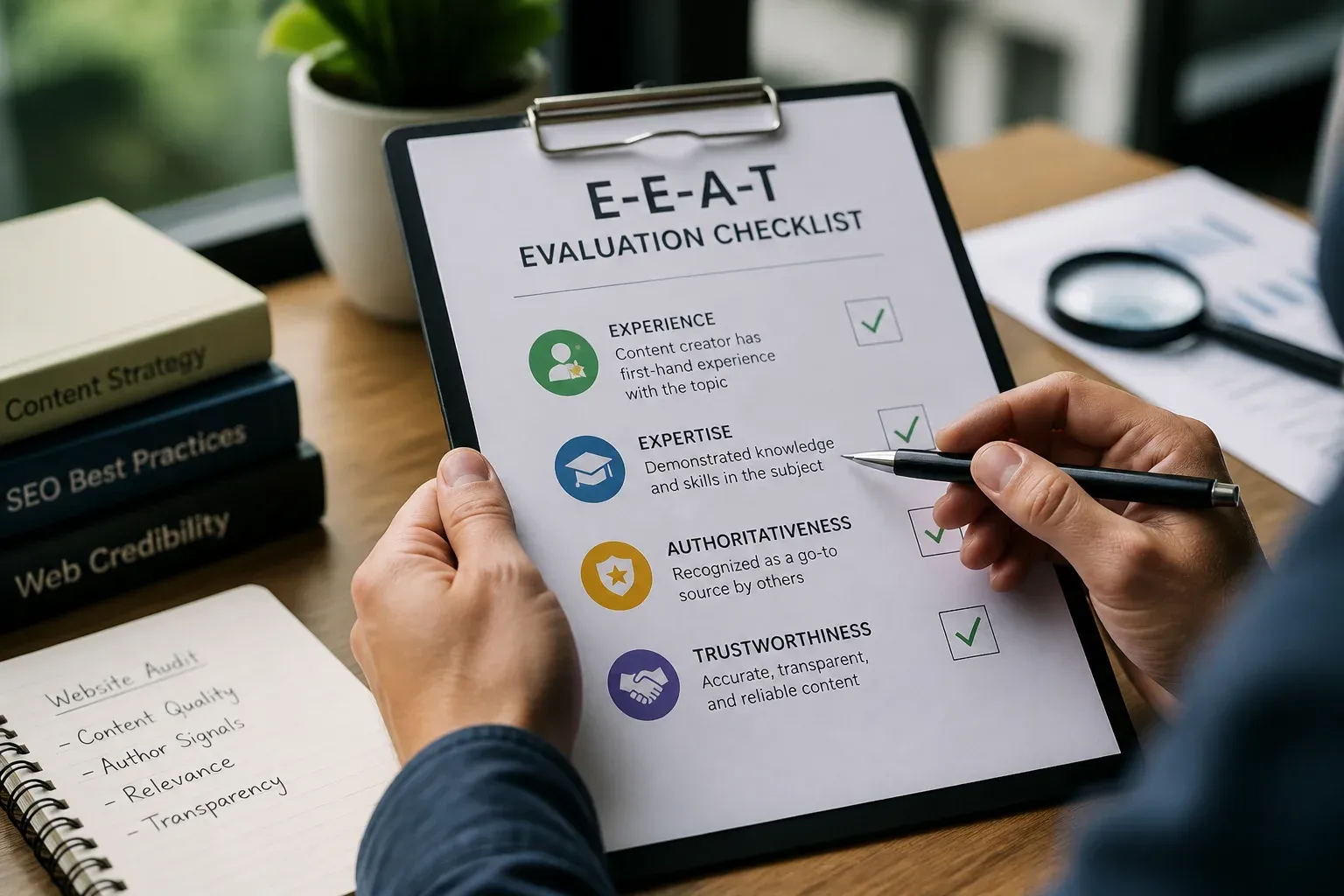
The E-E-A-T score in GEO Search Leads gives website owners and SEO agencies a clearer way to investigate credibility signals within a completed website scan. It helps turn a high-level assessment into practical questions: who is responsible for the site, what supports its claims, and where might visitors need more context to assess its information.
The score appears in the report summary alongside the GEO score, Improvements, and Checks passed. It is designed to support investigation and prioritization, not to replace editorial judgment or provide a final verdict on a website.
What the E-E-A-T score represents
E-E-A-T is a framework for considering experience, expertise, authoritativeness, and trustworthiness. Our summary displays an assessment out of 100 based on signals available to our analysis. Trust is central to the framework, while the relevance of individual signals depends on the website and its subject matter.
Here is what each concept means in practice:
- Experience is evidence that the people behind content have direct, first-hand familiarity with the subject. Original case studies, documented testing, practical examples, and photographs of actual work can help demonstrate this.
- Expertise is evidence of relevant knowledge or skills. Informative author profiles, applicable qualifications, expert review, and accurate explanations can provide useful context.
- Authoritativeness concerns recognition and reputation in the relevant field. Credible independent references, relevant industry recognition, and established professional contributions may be relevant.
- Trustworthiness concerns whether visitors can understand who is responsible for a website and reasonably rely on its information. Transparent business details, accessible contact information, clear sourcing, and appropriate policies all contribute useful context.
This assessment is our own evaluation of the signals available to the scan. It is not a score issued by Google, an official certification, or a direct measurement of how Google evaluates a website. It also should not be treated as a single ranking factor or as proof of rankings, AI citations, traffic, or inclusion in AI search results.

Read the score in the context of the full report
A number is most useful when it starts an investigation rather than ends one. Review the headline assessment alongside the report’s category breakdown and detailed findings to understand the observations behind it.
The Improvements and Checks passed cards summarize the overall scan. They provide important context, but their items are not necessarily all related to E-E-A-T. Within the detailed report, credibility-related observations, reported issues, warnings, explanations, and recommendations can help you decide what to verify on the actual website.
Automated analysis has limits. A scan may not detect information that lacks enough context, and it cannot replace a review of the site’s real-world evidence, editorial choices, or subject-matter requirements. Check the relevant finding against the published page before deciding what to change.
How to review credibility signals in a scan
Use a completed report as a structured review workflow:
- Sign in and open a completed website scan with detailed results. Start with a report that contains the full set of available findings.
- Locate the E-E-A-T score in the report summary. Review it alongside the GEO score, Improvements, and Checks passed to understand the overall scan context.
- Continue to the category breakdown and detailed findings. Review the available credibility-related observations, reported issues, and recommendations.
- Check each relevant finding against the actual website. An automated assessment may miss information or lack context, so verify the evidence before making changes.
- Prioritize improvements that clarify responsibility and credibility. Focus on what helps visitors understand who is behind the website, why its information is credible, and what experience or expertise supports its claims.
- Implement relevant changes. Depending on the site, this could mean clearer business information, informative author profiles, original examples, stronger sourcing, or more transparent policies.
- Run another scan after the changes are publicly accessible. Compare the available findings with the earlier report and investigate remaining gaps.
- Use the report in client conversations. Agencies can use it to explain completed work and next steps, while treating the score as an assessment aid rather than evidence of improved rankings or AI-search inclusion.
Practical ways to strengthen website credibility
The right action depends on the website, audience, and topic. The following are general recommendations, not a guaranteed list of automated checks.
Make responsibility and authorship clear
Identify the business or publisher and make useful About and Contact information easy to find. Where authorship matters, show who wrote or reviewed content and link to a profile that explains the person’s relevant background.
Demonstrate direct experience
Add original examples that show what was actually done and learned. Project details, testing methods, screenshots, photographs of real work, and case studies can provide context that generic claims cannot.
Make expertise and claims verifiable
Describe experience and qualifications accurately. For specialist subjects, use qualified reviewers when appropriate. Support important claims with reliable original sources, distinguish facts from opinion, and correct inaccurate or outdated information. Publication and update dates should change only when real work has been completed on the content.
Improve transparency and reputation
Make relevant business details, policies, commercial relationships, and sponsorship disclosures accessible. Build reputation through useful work and relevant contributions, rather than fake reviews, invented credentials, or unsupported authority claims.
Where appropriate, ensure Organization, Person, and Article structured data accurately reflects visible website content. Markup can help describe information, but it cannot create expertise or trust on its own.
A client-reporting workflow for agencies
An agency can open a client’s completed report, investigate a reported credibility gap, and check the relevant pages for missing or unclear information. The team might improve an author profile, add sourced explanations to an important page, or make business and policy information easier to locate.
Once those changes are publicly accessible, the agency can run another scan and compare the available findings with the earlier report. This creates a more grounded conversation about work completed, remaining gaps, and the next review priorities without presenting a score change as a guaranteed search outcome.
Ready to review a completed scan? Sign in to your account.
Frequently Asked Questions
What does the E-E-A-T score assess?
It assesses available signals related to experience, expertise, authoritativeness, and trustworthiness within a website scan. The score is our assessment, not a Google-issued score, official certification, or direct measurement of how Google evaluates the website. Its value is in guiding further investigation of the report findings and the published website.
Is the score a Google ranking factor?
No. It should not be treated as a single Google ranking factor or as proof that a website will rank better. Improving website information may help clarify credibility for visitors, but the score does not guarantee rankings, traffic, AI citations, or inclusion in AI search results.
How do the Improvements and Checks passed cards relate to this assessment?
They summarize the overall website scan and provide context for the report summary. Not every item in those cards is specific to E-E-A-T. Review the category breakdown and detailed findings to identify the credibility-related observations, issues, warnings, explanations, and recommendations that are relevant to your investigation.
Why should I verify findings on the website before making changes?
Automated analysis may miss information or lack the context needed to interpret it correctly. Reviewing the actual page helps you determine whether a finding reflects a genuine gap, whether supporting evidence is already available elsewhere, and which change would be useful for visitors.
What improvements can help demonstrate experience and expertise?
Useful improvements may include original examples, project details, testing methods, case studies, informative author profiles, accurate qualifications, qualified review for specialist topics, and stronger sourcing. The appropriate changes depend on the website and topic, so use the report as a prompt to investigate rather than a fixed checklist.
Conclusion
The E-E-A-T score gives you a focused starting point for discussing website credibility, then connecting that assessment to the evidence visitors can actually see. By reviewing detailed findings, validating them against the site, and rescanning after relevant public changes, website owners and agencies can build a clearer improvement plan and explain next steps with greater precision.